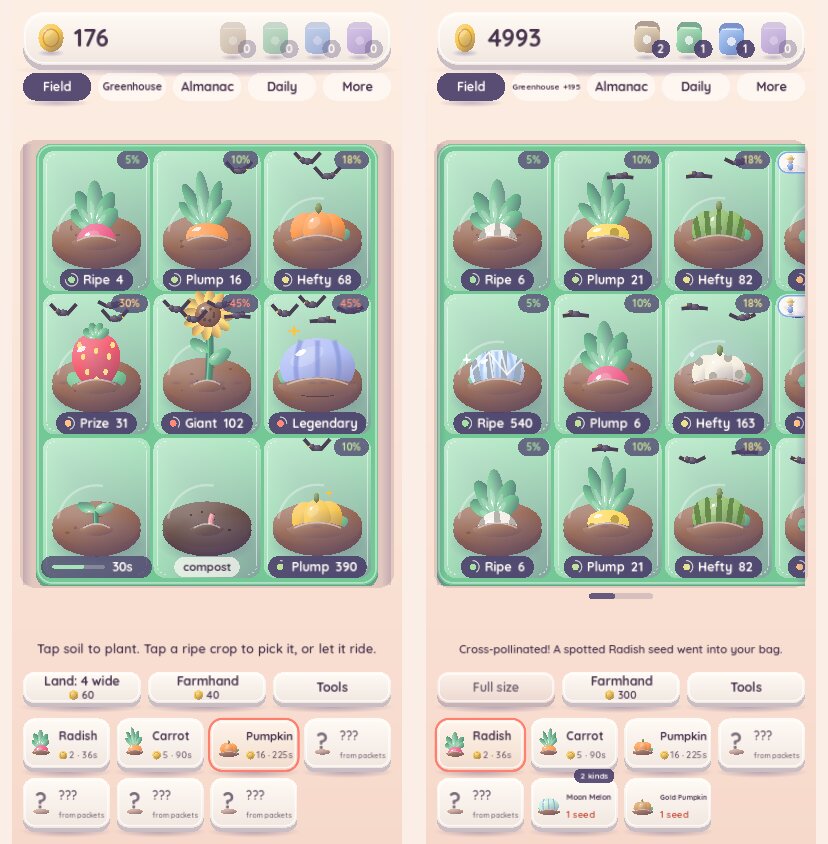
Every browser farm game I remember asks for one thing: come back on time. Crops wither, energy refills on a timer, and the whole loop is built around the guilt of leaving. Oddseed started from the opposite question. What if a ripe crop just kept growing, and the only thing you had to decide was when to stop?
Let it ride
A crop ripens on a timer (36 seconds for a radish, four and a half minutes for a Golden Pumpkin) and then keeps overgrowing, one stage every 12 seconds while the game is open. Ripe, Plump, Hefty, Prize, Giant, Legendary. Every stage is worth more, from 1x up to 4.5x, and every stage raises the chance that the next tick goes wrong: blight takes the crop (and leaves compost behind, which grows the next one 1.5x faster), crows knock it back two stages, and a storm flattens a whole row of overgrown crops back to Ripe. You can harvest at any time. That’s the entire game, and every harvest is a decision.

I wanted the math to actually push back, so the game has a self-play script: a field of carrots replanted the moment a plot is empty, harvested by a fixed rule, for an hour of game time over a couple dozen seeds. Coins alone peak at Prize, 83 a minute against 68 for riding everything to Legendary. Riding past Prize only pays in seed packets, and Giant and Legendary drop much better ones. So the real tension is greedy for coins against greedy for seeds, which is exactly where I wanted it.
The first prototype got this wrong. Crops ripened in 12 to 90 seconds, and harvesting at Ripe beat everything, because a crop riding its ticks is a plot not being replanted. Riding only pays when a regrow costs several ticks, so the grow times went up until the self-play agreed.
The other rule I care about: nothing overgrows, rots or withers while you’re away. Crops ripen and stop. The gamble only happens while you’re watching.
Packets and strains
Harvests drop seed packets, and the tier depends on how late you harvested: Common up to Hefty, Uncommon at Prize, Rare at Giant, Heirloom at Legendary. Opening one is the little slot-machine moment the game is built around (with nothing for sale and nothing to buy, the only thing you ever risk is crops you grew). Four crops only come from packets, and an Heirloom always holds a Moon Melon or a Golden Pumpkin.
Every seed is a strain: a crop, one of four colors, a pattern (plain, striped or spotted) and maybe a variant. Golden is worth 3x, glowing 2x, crystal 5x, and a seed is a variant about 1 time in 200. Harvest a ripe crop next to a ripe crop of the same kind and there’s a 15% chance of a hybrid seed (40% next to a beehive) that takes its color and pattern from either parent, and a parent’s variant a quarter of the time. Each crop has 15 kinds to find for the almanac.
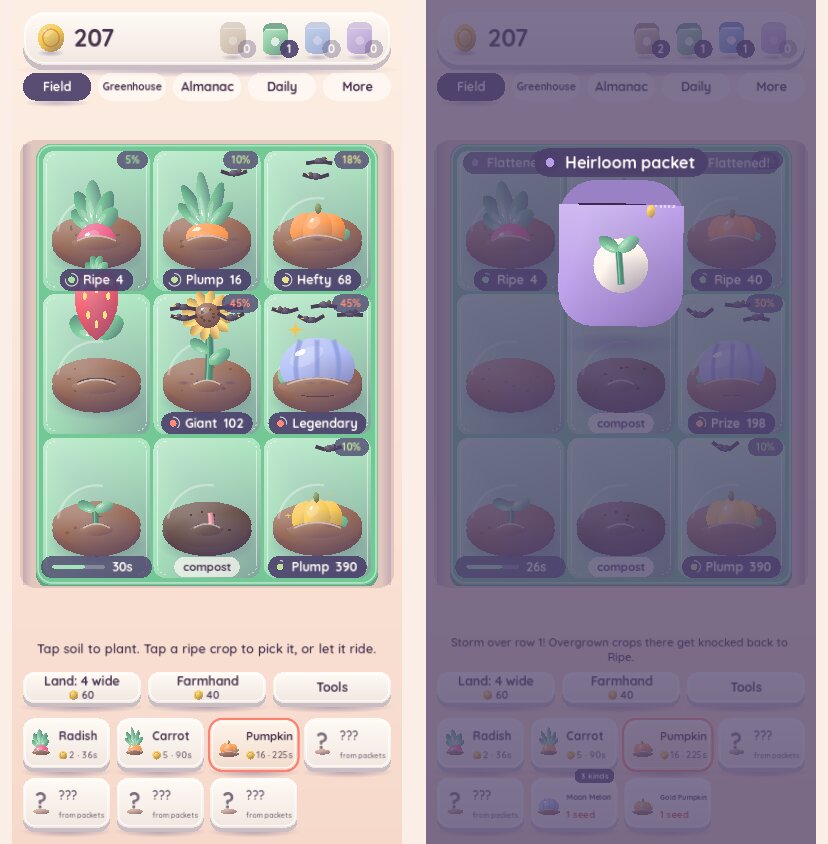
Rarity numbers like that are easy to set and hard to feel, so there’s a second self-play script for breeding. It plants one crop, harvests at Prize and opens every packet, and counts hours of play until the first variant. A variant of the crop you’re breeding shows up in one to three hours of play, which at half an hour a day is a few days. A crystal radish or carrot takes 6 to 15 hours. A crystal pumpkin takes about 28 even with a beehive, and I left it there on purpose. Something should take a month.
The greenhouse
The field is the active game. The greenhouse is the reason to come back: pot a seed and it grows slowly, then earns coins every minute forever, with no risk and no tapping, including while you’re away (up to eight hours of it). A crystal Moon Melon earns 225 a minute, which is what makes breeding worth the effort.
Picking a look
Like the other browser games, everything on screen is drawn from primitives. No sprites, and the sounds come out of a Python script. The first version was flat and readable but didn’t have much personality, and it fell apart as the field grew. Buying land zoomed the whole field out until a 5x5 field had text too small to read on a phone.
So I put together four mockups, all animated and all playable on a phone: a cut-paper diorama, a tiny tabletop island seen from above, soft clay, and a dusk garden lit by lanterns. My only requirements were motion and depth. Everything has to move a little when it’s left alone, every action has to move, and you should be able to tell what’s in front of what wherever things meet: a seed going into its packet, a plant in the ground.
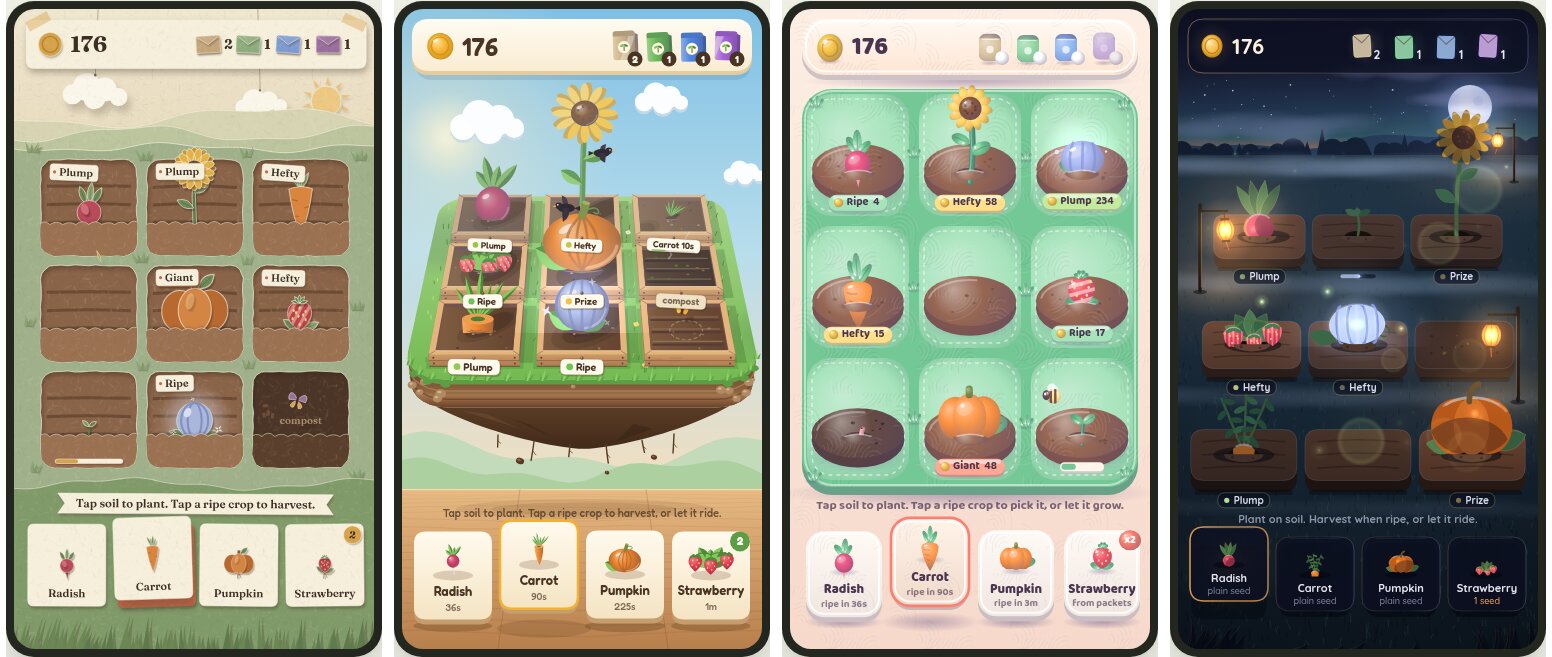
Clay won without much of a fight. Every crop and card is a soft volume lit from the upper left, with a cool lavender shadow instead of black, and a soft contact shadow that tightens when something presses down. A few rules came out of picking it:
- Plants are planted. Every crop has a part below the soil line (a carrot is mostly root, a radish half under) and only what’s above the soil is drawn. A harvest pulls the crop up through that line, so the root slides out of the dirt.
- Text doesn’t move. Shapes bounce and squash all they want, but labels and counts sit still and only fade. Wobbly text is just hard to read.
- The field scrolls instead of shrinking. It stays three rows tall, buying land adds columns, and you drag sideways once it doesn’t fit. Plots are the same size on day one and on a full 3x8 field.
Drawing all of that in GDScript every frame was slower than the old flat look, so the shapes are cached as little meshes and stretched into place. Only the parts that actually cross the soil line get clipped by hand.
The daily field
Like Pachinko Descent, Bulwark and Coterie, there’s now a daily field: one seeded field a day, the same for everyone, with a leaderboard. It’s turn-based so nobody has to wait. You plant and harvest, then tap Next turn and one tick passes at once. Forty turns, and your score is the coins you’re holding at the end.
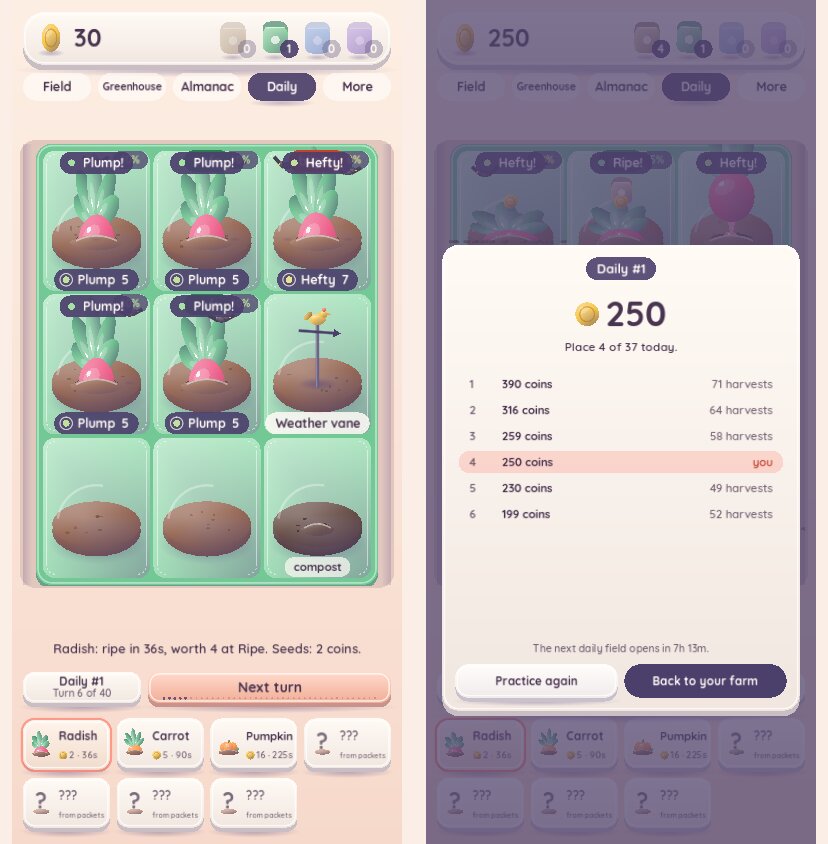
A daily is only fair if it plays the same no matter what order you do things in, and a farm makes that hard. Normally every roll of luck comes off the same random stream in order, so planting one extra radish would change the fate of every crop after it. On a daily, each roll is keyed to the day and the moment instead: a crop’s next tick to its plot, stage and step, a packet’s seeds to how many of that tier you’ve opened. Plant the same seed on the same plot on the same turn as anyone else and you’ll see exactly the same ticks they did, whatever else you planted. The tests check that by playing two farms side by side, one of them busy elsewhere.
It’s at oddseed.twinspear.com. Harvest at Prize. Or don’t.