Announcing Credential Broker

tl;dr: The utility is open-source, you can download, contribute or learn more on github here. A credential broker service stores all sensitive information and has a command-line client which can act as a streaming pre-hook to initialize environment variables upon an application at runtime that does not store anything to disk. The broker service itself stores everything in encrypted format with the broker client having a key to unlock the data, provided the user is authenticated and has been authorized for the data requested. The server mimics an SSH authentication using Diffie-Hellman to establish encryption of traffic, performing a challenge to validate a user owns the private OpenPGP key to their account and a 2FA request at a configurable time period to ensure the user hasn’t been compromised. SSL should be configured on the server to help prevent man-in the middle. ...

April 7, 2021 · 3 min

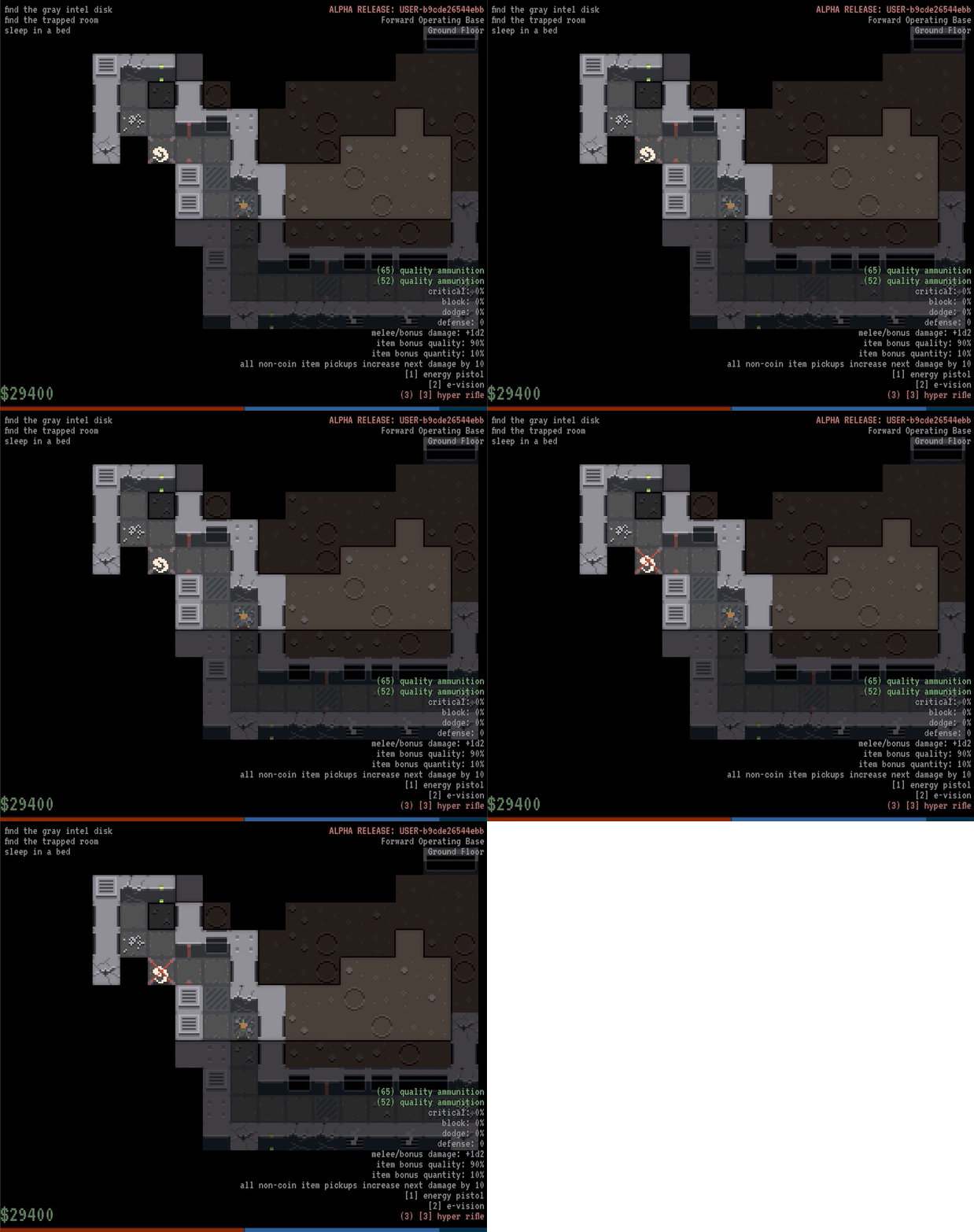
Kepler452b Released

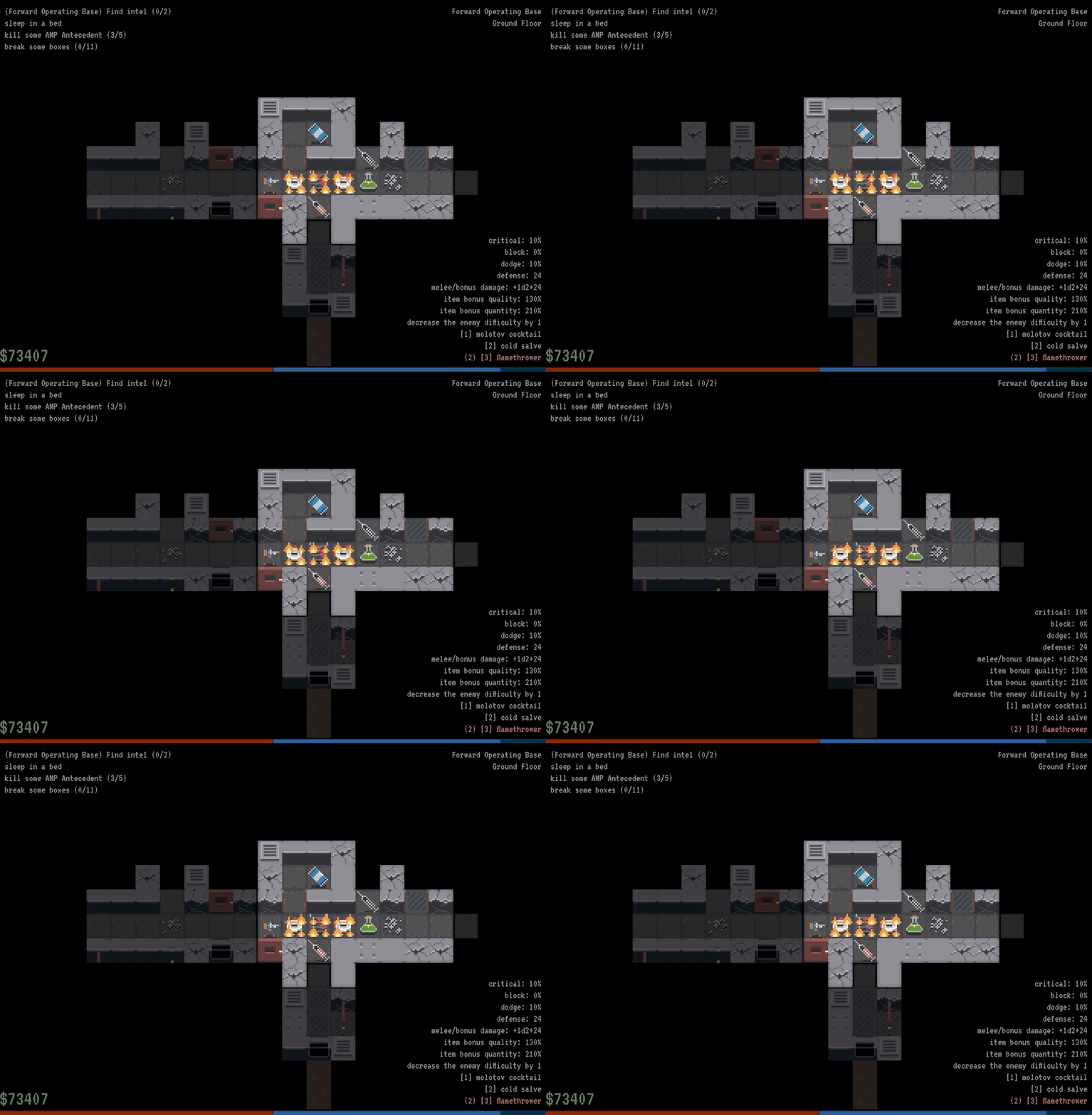
Kepler452b is available for Windows, Linux & MacOS. Enjoy a roguelike with one of 8 classes, 5 unique worlds, beautiful graphics by Oryx, music by Scott Buckley & Sergey Cheremisinov, 28 unique enemies, 101 supervisors to modify your gameplay, a story and much more! Whether you prefer to sneak around and backstab with the assassin, use a flamethrower as a pyrotechnic or grapple enemies to you and poison them, there’s bound to be a play style you will enjoy! ...

August 4, 2020 · 1 min

XMLHttpRequest Security

It’s possible to intercept, adjust and otherwise tamper with a XHR request with javascript in the browser. The most common way of doing this is simply making a pointer reference to the original XMLHttpRequest.prototype.send function, overwriting that function with a new one that does the tampering and then calls the original send function once finished. Here’s an example: const XHR = XMLHttpRequest, XHRopen = XHR.prototype.open; XHR.prototype.open = function() { onFinish(); XHRopen.apply(this, arguments); }; Identifying Tampering It’s very straight forward to identify tampering of the function. Simply ensure that the XMLHttpRequest.prototype.open.toString() === 'function send() { [native code] }'; evaluates to true. The function should always be native code if it wasn’t corrupted or tampered with. ...

June 2, 2020 · 2 min

Kepler452b Coming 2020

August 4th, 2020 Update: v1.0.0 Release Official release page is here. You can submit bugs or request features here. Downloads & Links Windows Download Mac Download Linux Snapfile Download Linux App Image Download Screenshots ...

December 3, 2019 · 2 min

Building a Modern Roguelike in 2019

At numerous times I’ve created demos trying to figure out how to merge a traditional roguelike into a FPS without sacrificing it’s roots. Here’s an article I made in 2017. Unlike many others I don’t feel like just random maps makes a roguelike, I’ve even gone so far as saying no FPS is a roguelike. In this experiment I’ve tried to merge those ascii characters into the map itself and dropped the textures. The code can be executed and ran or viewed in its entirety on Github here. ...

November 13, 2019 · 1 min

Mapping Genealogy in Neo4J

This summer I’ve worked on a behavior and trait mapper in C++ that establishes entirely dynamic AI routines, allowing actors to propagate and interact with each other in unique ways. You can think of it as a super sophisticated Langton's Ant, where the goal was to identify the reflective sociological impacts of personal traits from as minute and mundane as a vegan to criminal desires like burglary, sexual preferences like pansexual or uncontrollable hunger desires of a cannibal, etc. The graphing of the application was with Vis.js. ...

July 26, 2019 · 2 min

Runtime Pipeline Patterns

Introduction Pipeline patterns are most commonly used for simple data workflows like general functional composition or user registration processes. After briefly describing the basics, this article focuses on a couple of behavioral software design patterns under the strategy pattern we’ll refer to as “runtime patterns” for use with pipelines. Their power in modern applications is allowing pipelines to expand or contract dynamically. Whether it be through behavior modeling with ai, blueprint fulfilling or more basic conditional pipeline adaptation, the runtime patterns are helpful and with forethought can be simply understood and implemented. ...

February 25, 2019 · 4 min

Async Await Chaining

Creating synchronously chained functions is straight forward. Codepen. const UserCollectionSync = { find(id=''){ document.writeln('1'); return this; }, update(){ document.writeln('2'); return this; }, save(){ document.writeln('3'); return this; } } UserCollectionSync .find() .update() .save(); But when we decide to just throw some ‘async’ ‘await’ flags on those functions everything doesn’t work. FOLLOWING CODE IS WRONG: Codepen. // delay is used to represent some asynchronous work function delay(ms){ return new Promise(resolve => setTimeout(resolve, ms)); } //end delay() const UserCollectionAsync = { async find(id=''){ await delay(1000) document.writeln('1'); return this; }, async updateFor(options={}){ await delay(50); document.writeln('2'); return this; }, async save(){ await delay(50); document.writeln('3'); return this; } } UserCollectionAsync .find() .updateFor('') .save(); The reason it fails is because when the ‘find()’ is called it returns a promise that hasn’t resolved instead of the ‘UserCollectionAsync’ object (Factory pattern.) Therefor you can’t find a function ‘update()’ on a promise. One common way of solving the issue is by allowing the factory to maintain a queue and force the user to add ‘done()’ at the end of the chain: Codepen. ...

January 6, 2019 · 3 min

Meander Algorithm

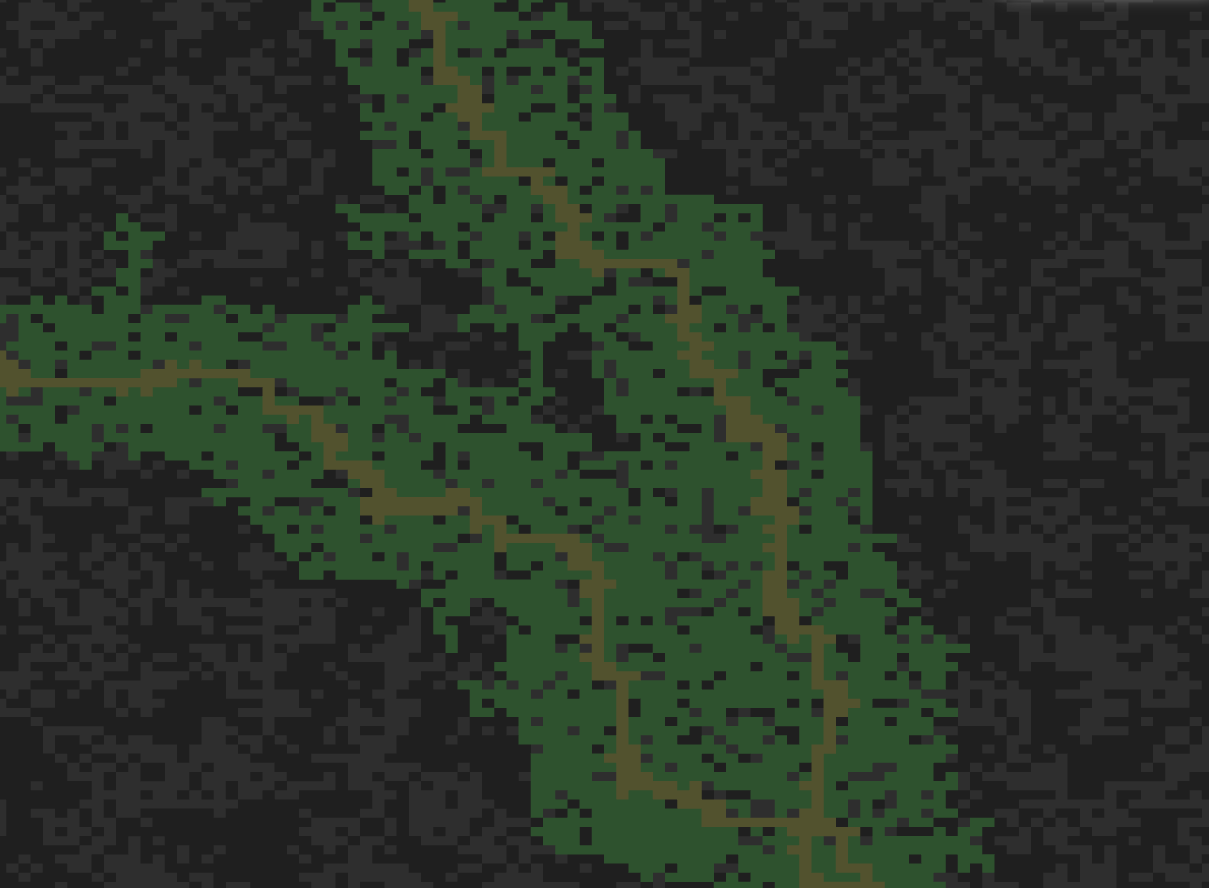
The meander algorithm is a combination of using mazes to allow a meandering with bresenhams line. Below you can see the actual algorithm in simplicity. Obviously you could use noise maps to created heighted terrain based on the river to make it look pretty. Choose a starting map edge and ending map edge, acquire the terminal points based on those edges. Usually this would be a random point on those edges. Maybe you’d want to weight it so it’s predominately in the center, or you could restrict it to a certain part. Create Bresenhams line between the terminal points. This is called the pathing vector. Break up the pathing vector into chunks of 9x9 where the pathing vector crosses the center. There may be left-over of the pathing vector. For each chunk, perform a recursive maze generation algorithm on the chunk. Repeat this step until there is a path from the start of the pathing vector within the chunk to the end of the pathing vector in the chunk. A* pathing algorithm can be used for the pathing. Merely use Bresenhams line to wrap up the extraneous pathing vector not covered by chunks, alternatively break up the remaining path into the largest odd number and chunk and process it similarly to the previous part of the algorithm to make it more consistent. Left overs in this optional way would still be filled in with bresenhams line. Recursive Maze Generation: ...

September 4, 2018 · 2 min

Generating Exhumed River Channel

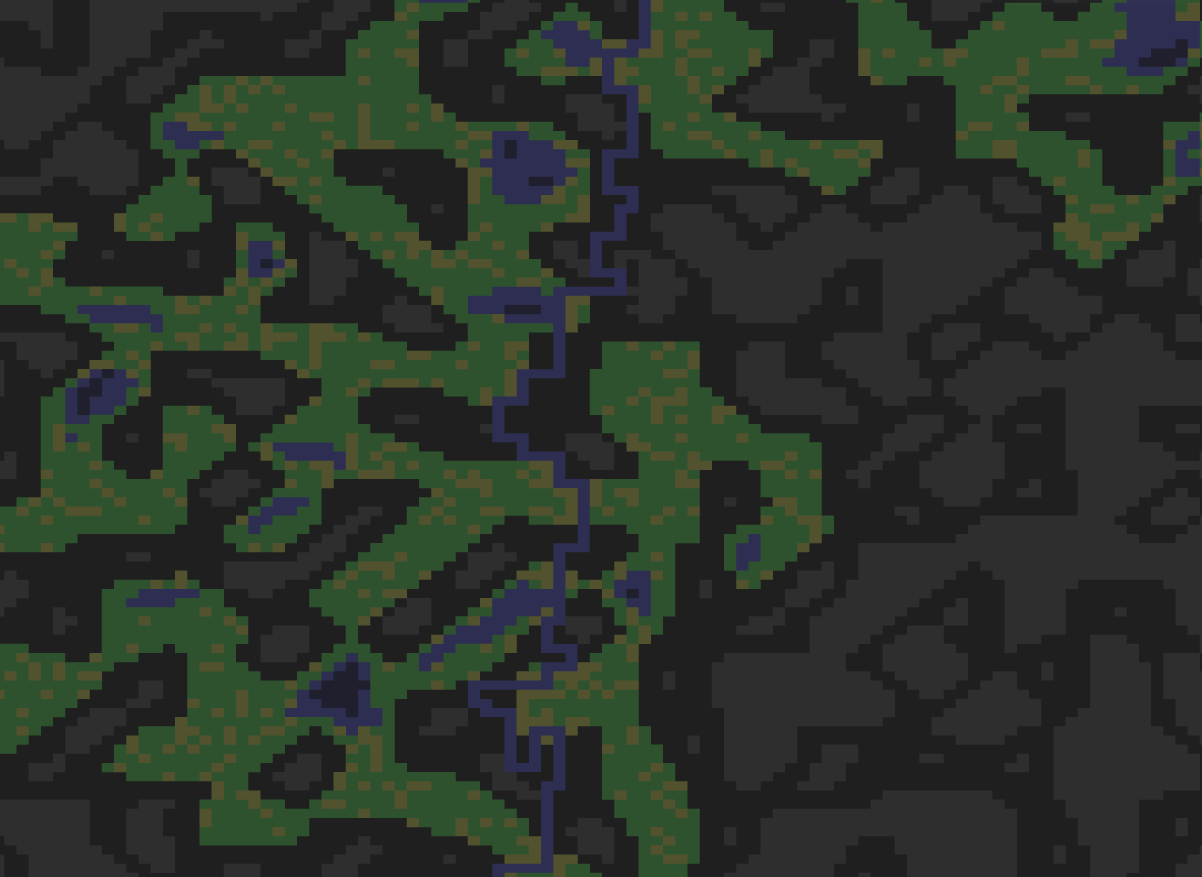
I recently did some work in generating rivers in a 2d game. Revisiting this work to create an exhumed river channel, I decided it might be fun to revisit how to generate it to make the channel look more realistic. Instead of using a drunken walker, this is a more expensive but interesting map generator: Start by generating 2d simplex noise where less <0.6 is floor rest is walls Generate terminal lines at each map exit (north, south, east, west). Shuffle those lines and randomly choose a start and end location for the river based on two of those lines. Later you can add another line with terminal point to allow a split river channel ...

August 6, 2018 · 1 min