Composition Over Configuration in Compass

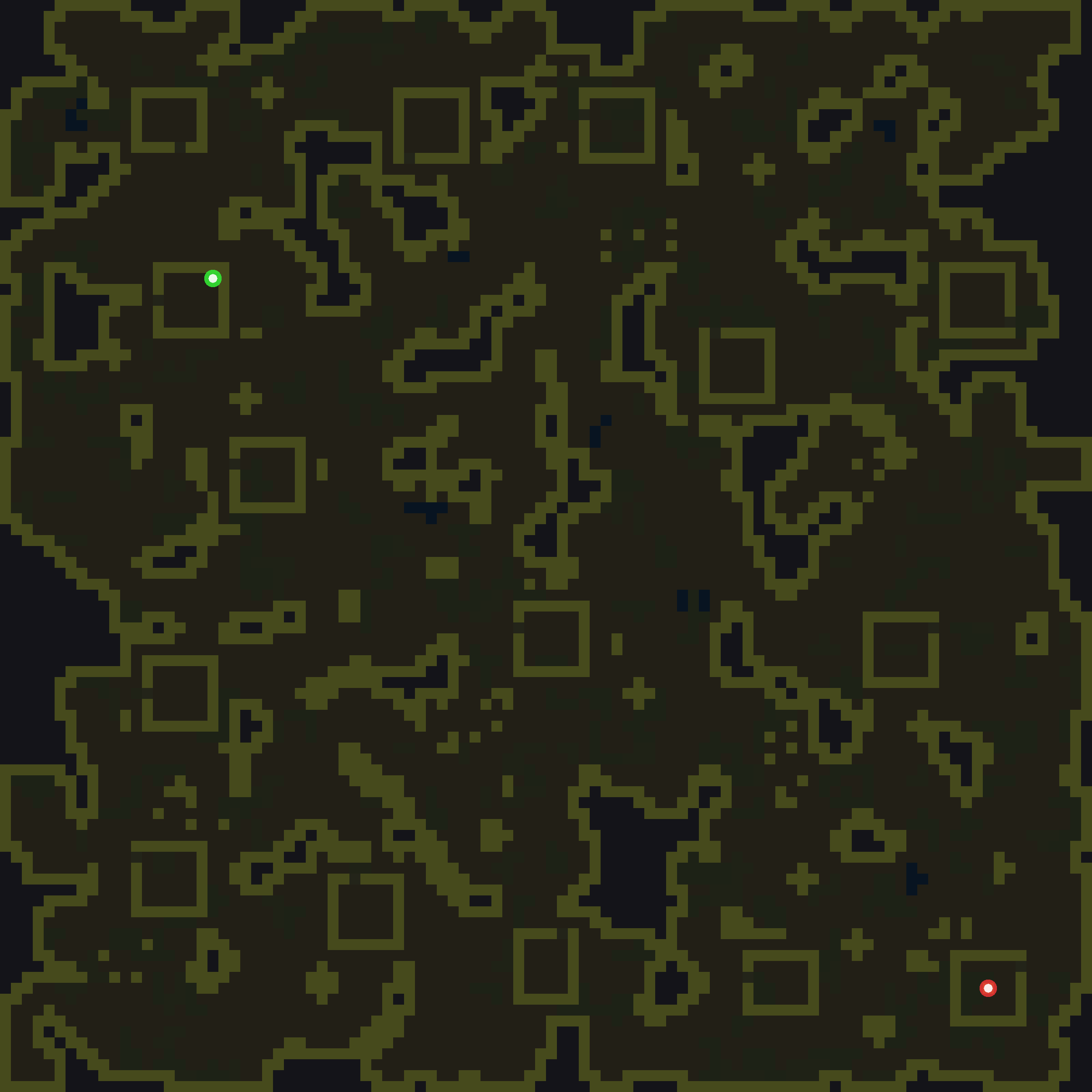
The individual generators in compass (the arroyos and rivers, the caverns and meanders) are the fun part to show off, but they aren’t what makes the library usable. The part I’m actually proud of is the composition layer that sits on top, and it owes a lot to the runtime pipeline patterns I wrote about a while ago. Shapes times features Every room is described as a shape combined with a feature. There are 24 shapes: squares and circles, but also blobs, crystalline caverns, crescents, capsules, and a handful of hallway types. There are 18 features: pillars, islands, stepping stones, pools, moats, chasms, rubble, and four kinds of river. Any shape can pair with any feature, which is 432 distinct room configurations before you’ve placed a single one. A feature is just two functions: an initialize step that works out the geometry (the meandering river feature, for example, generates a sine-wave centerline and expands around it), and a content step that decides the terrain type for each tile inside the shape. Keeping those two responsibilities separate is what lets the same river feature drop into a square room or an L-shaped hallway without caring which it landed in. ...
October 13, 2024 · 3 min

Meander Algorithm

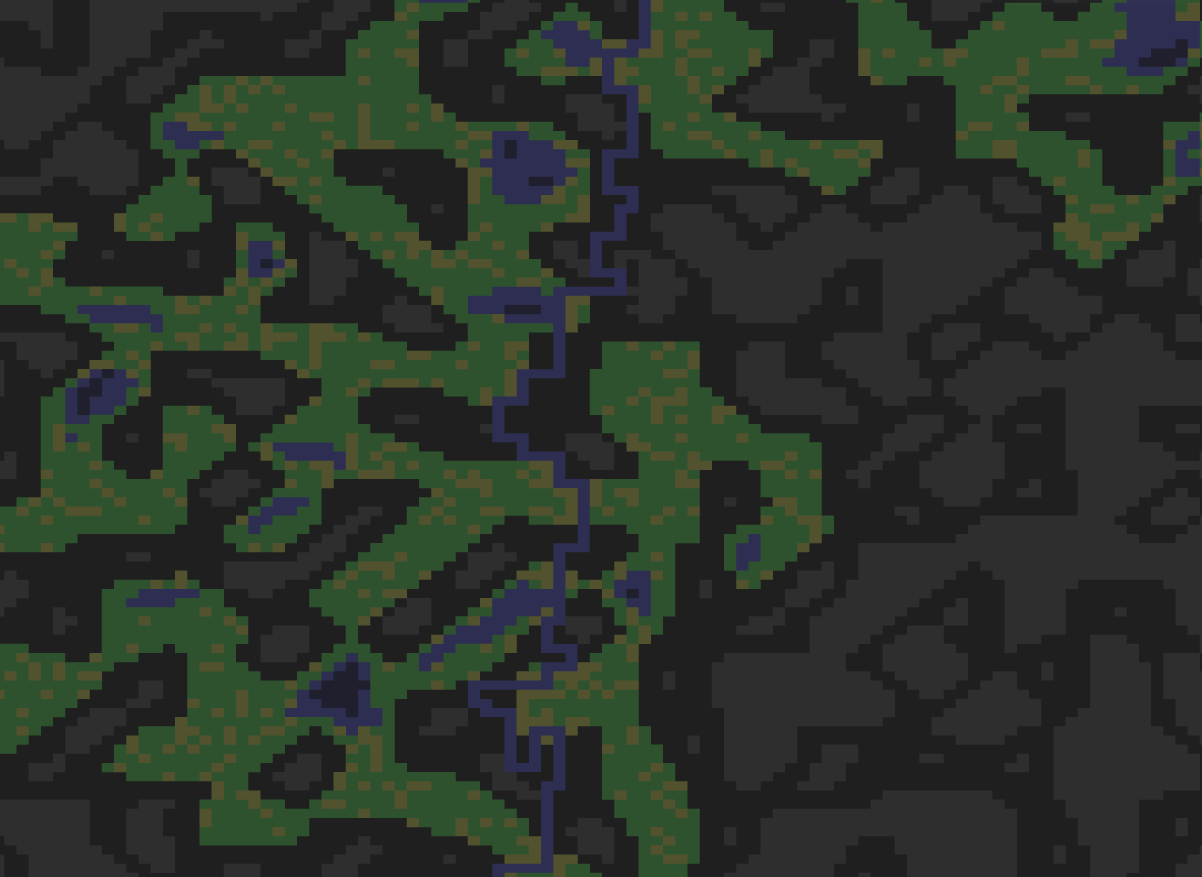
The meander algorithm is a combination of using mazes to allow a meandering with bresenhams line. Below you can see the actual algorithm in simplicity. Obviously you could use noise maps to created heighted terrain based on the river to make it look pretty. Choose a starting map edge and ending map edge, acquire the terminal points based on those edges. Usually this would be a random point on those edges. Maybe you’d want to weight it so it’s predominately in the center, or you could restrict it to a certain part. Create Bresenhams line between the terminal points. This is called the pathing vector. Break up the pathing vector into chunks of 9x9 where the pathing vector crosses the center. There may be left-over of the pathing vector. For each chunk, perform a recursive maze generation algorithm on the chunk. Repeat this step until there is a path from the start of the pathing vector within the chunk to the end of the pathing vector in the chunk. A* pathing algorithm can be used for the pathing. Merely use Bresenhams line to wrap up the extraneous pathing vector not covered by chunks, alternatively break up the remaining path into the largest odd number and chunk and process it similarly to the previous part of the algorithm to make it more consistent. Left overs in this optional way would still be filled in with bresenhams line. Recursive Maze Generation: ...

September 4, 2018 · 2 min