Pigeon Hole Stepping v2

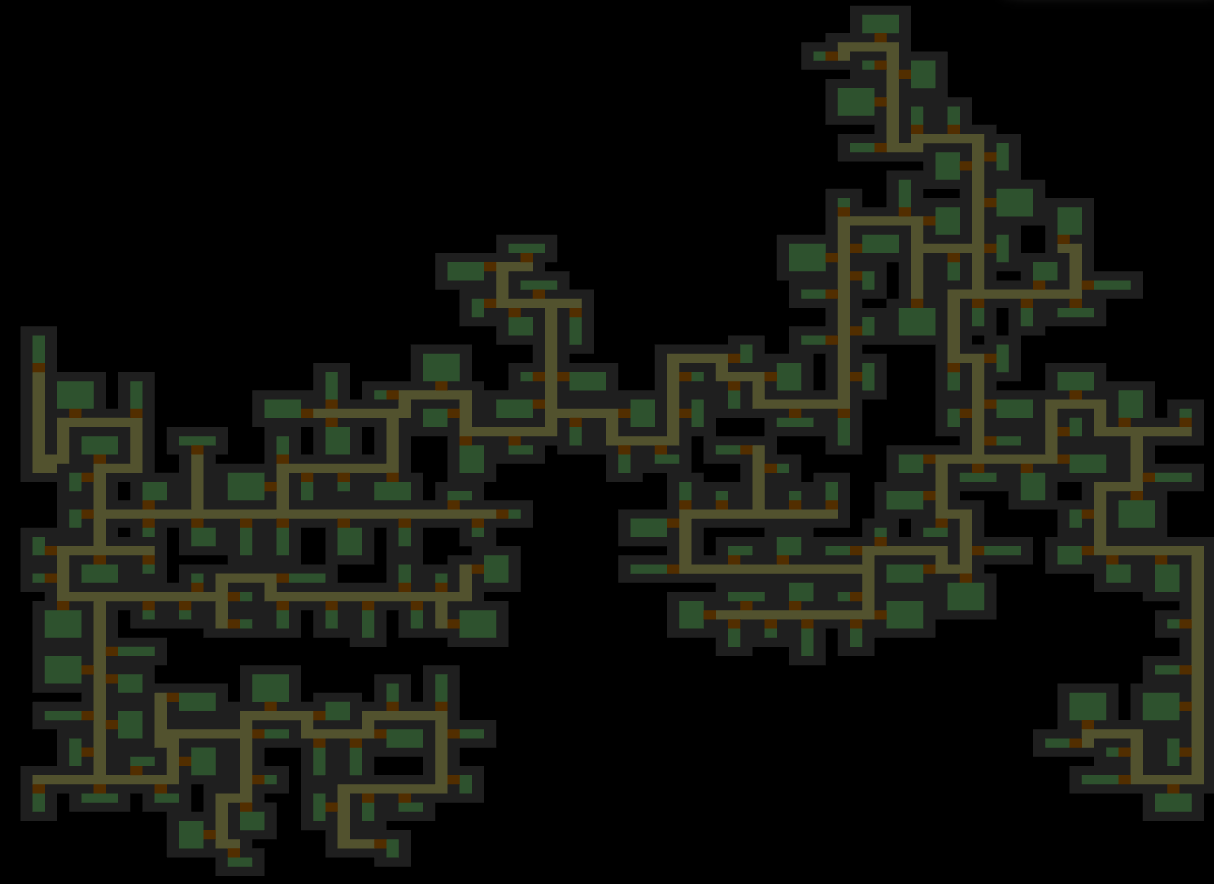
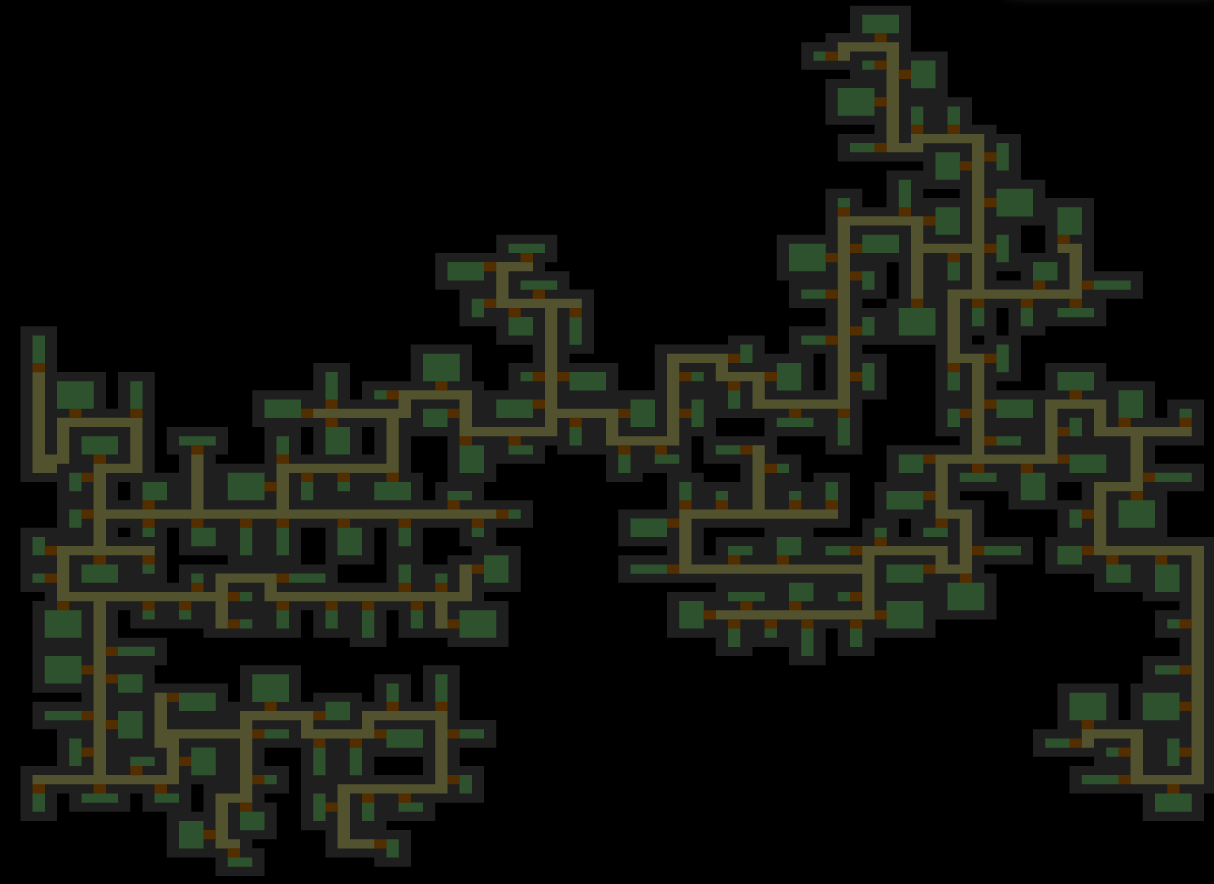
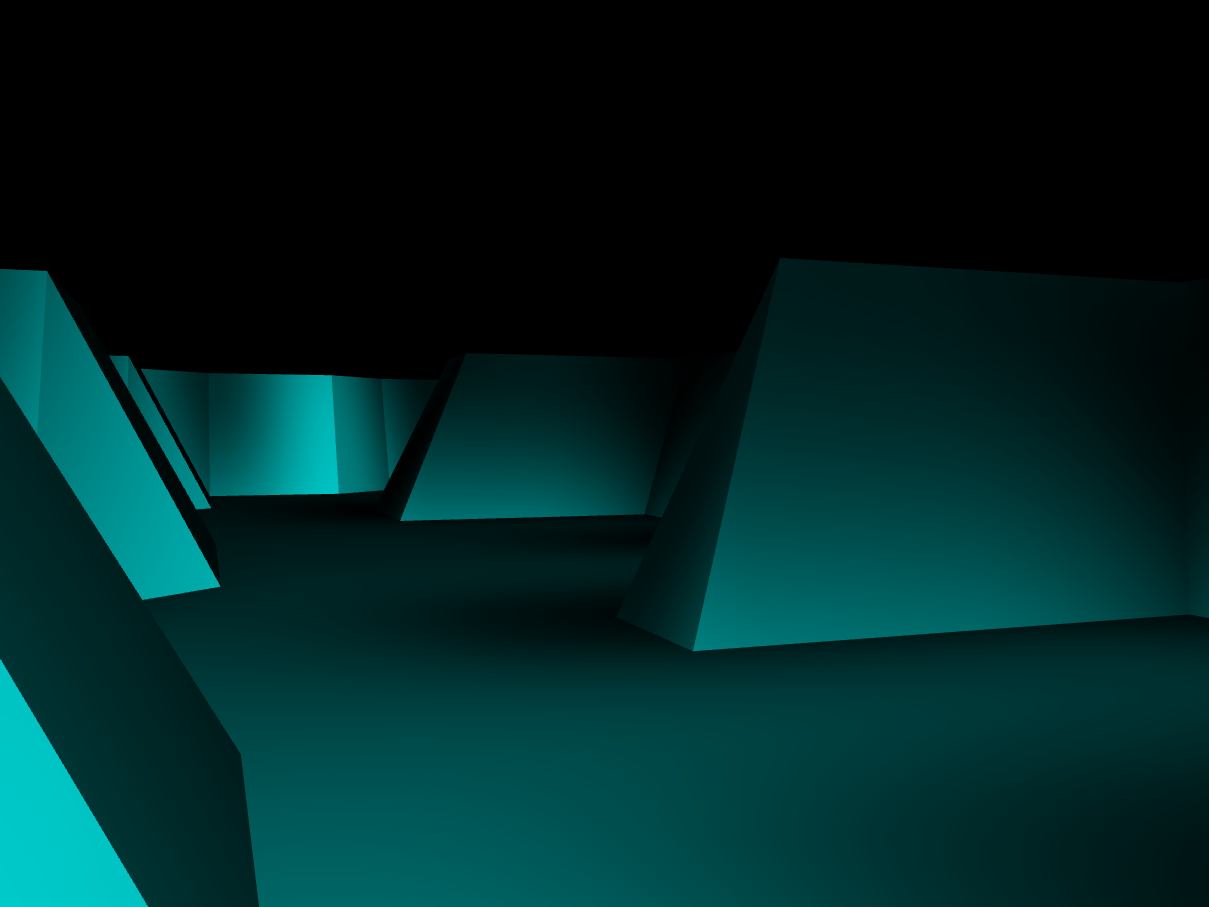
I had originally written an article on how to implement PHS. Having found the maps generated slightly redundant I decided to take another look. Here are the steps taken to successfully generate a more realistic town. It’s essentially a drunken walker like Diffusion Limited Aggregation mixed with a hallway constraint that mimics the large part of PHS. Start somewhere in the middle, add this and all possible directions up to a certain dynamic length (I used a standard deviation of 1.4 with a mean of 5, ) as nodes: [{x,y,direction},...]. We will be looping until all nodes and edges (we’ll describe that shortly,) are gone. When we have node then check to see if the path between it’s ‘x,y’ and ‘x2,y2’ (given the length and direction) is clear. If it is, then add the entire path minus the start and end as edges, and add the end as a new node. Shuffle nodes after adding a new one. After building the path run through the path array randomly attempting to build a room in all directions. (this won’t be entirely possible and will leave negative space to fill with edges.) If there are no nodes, repeat step 3 except with edges (this helps fill the map negative space.) After all nodes and edges are gone then cover all cells adjacent to floors with walls if it’s empty. I found it helpful to use this simple formula to generate hallway lengths with a mean and standard deviation constraint. Both the x and y would work fine, here we’re using the y only. ...
May 8, 2018 · 2 min

Textures make a difference

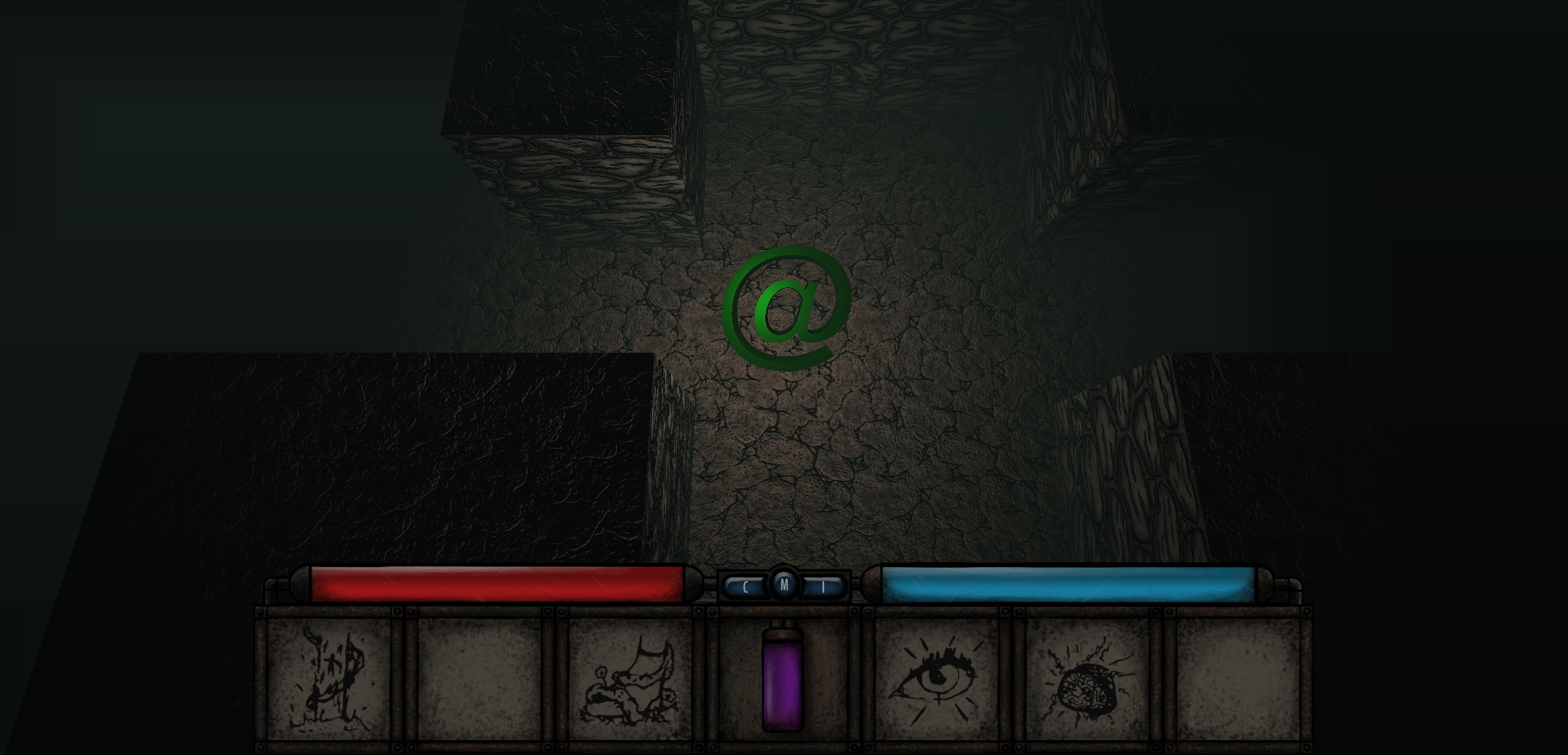
I’ve been playing around with textures in exploring the bleak to see how much of a difference it would make. Essentially I’m torn between two ideas: Make the floors all a plain color and glow them based on the environment color so as not to be too realistic and keep a more roguelike feel. Struggle with having textures that blend together between sectors so it has a more natural feel albeit simple in perspective to traditional 3d games. At the moment I’m leaning towards number two, but I haven’t been able to reproduce a reliable glow postprocessing effect that I actually like and that feels natural. I’ll follow down both roads further before making a discrete decision. ...

March 22, 2017 · 1 min

No FPS is a Roguelike

I’ve struggled with the concept of merging the roguelike turn-based system with a FPS. Having a turn based on when you fully leave a cell makes the monsters seem jumpy which doesn’t make for very nice gameplay. Because I believe turn-based systems are core to roguelikes and first person shooters can’t be turned based in a cohesive way, I’ve dropped the FPS perspective altogether and pulled the camera above the player. ...

March 10, 2017 · 1 min

Building A Modern Roguelike in 2017

Building games has become easier to do with the increase in quality of tooling and specialization software. The unfortunate side effect is the developer has to become more trained and specialized in a variety of facets in order to maintain competency in the field. Ergo building games is also harder. This year for the 7DRL competition I’ve been pretty lazy, which doesn’t help much to making deadlines. Setting aside playing games for making games I decided to finally venture into the competition whole heartedly. ...

March 8, 2017 · 2 min

Pigeon Hole Stepping

For 7DRL this year I developed a new map generation algorithm called Pigeon Hole Stepping. Fill the map with walls This map generation algorithm relies on negative building techniques. This concept will make more sense as the later steps are explained. Dig Hallways Essentially, we can assume that hallways that are parallel to each other are at least the length of a single room and up to two rooms apart in distance. Because of this assumption, we can make a random walker that will move around with this restriction in mind until map is filled completely. ...

March 8, 2016 · 2 min

Automata Generated Caverns

Randomly generated dungeons are a lot of fun to program, but sometimes they can be pretty difficult to originally wrap your head around. For this years 7DRL I added Automata Generated Caverns as one of the algorithms I wanted to figure out completely. You can read more specifically on the theory here.

November 13, 2015 · 1 min